


On 2 November 2026, the IAMC Inaugural Online Conference, organized by the International Association of Maritime Clusters (IAMC), brought together maritime cluster representatives and industry professionals to discuss some of the key challenges shaping the global maritime sector.
The conference programme centred on three key debates addressing shared opportunities and challenges across the global maritime cluster community: “Cooperation in a Competitive World,” “Talent Without Borders” and “Small Cluster, Big Voice.”
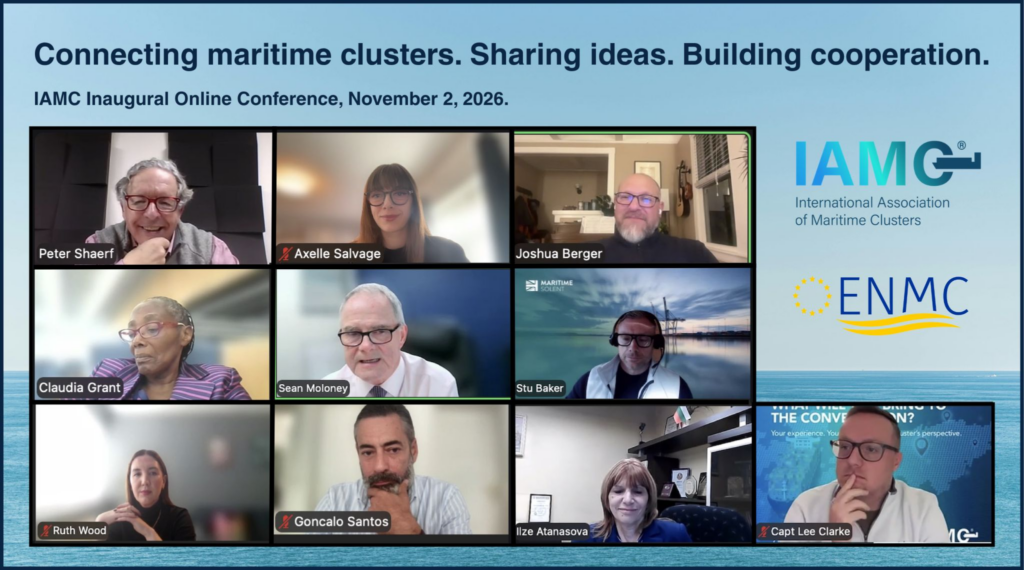
The opening panel, “Cooperation in a Competitive World,” featured Axelle Salvage, Coordinator of the European Network of Maritime Clusters (ENMC) and Cluster Manager of Luxembourg Maritime Cluster. Her participation was particularly significant for the Ukrainian Maritime Cluster as a member of ENMC. Together with fellow panelists, Axelle Salvage brought valuable insights and experience to the discussion on international cooperation between maritime clusters, underlining the importance of dialogue, knowledge exchange and collaboration across the global maritime cluster community.
Alongside fellow panelists, Axelle Salvage brought valuable insights and experience to the discussion on international cooperation between maritime clusters, emphasizing the importance of dialogue and collaboration across the global maritime cluster community.
The second session “Small Cluster, Big Voice,” focused on the contribution regional maritime clusters can make to an inherently global industry and on how cooperation can help their expertise, experience and priorities gain greater international visibility.
The panel brought together representatives of maritime clusters from different European maritime regions:
- – Ilze Atanasova, Chair of the Management Board of Maritime Cluster Bulgaria;
- – Lee Clark, Managing Director of Isle of Man Maritime;
- – Ruth Wood, Chief Executive of Mersey Maritime;
- – Stuart Baker, Chief Executive, Maritime Solent.
From regional expertise to a stronger international voice
One of the central messages of the panel was that regional maritime clusters bring a perspective that larger national and international organizations cannot always provide.
While major maritime centers offer scale, infrastructure and access to global markets, regional clusters provide direct connections to local businesses, research and educational institutions and public authorities. International networks such as IAMC allow these regional perspectives to come together, exchange experience and develop a stronger collective voice.
Black Sea cooperation and the Ukrainian Maritime Cluster
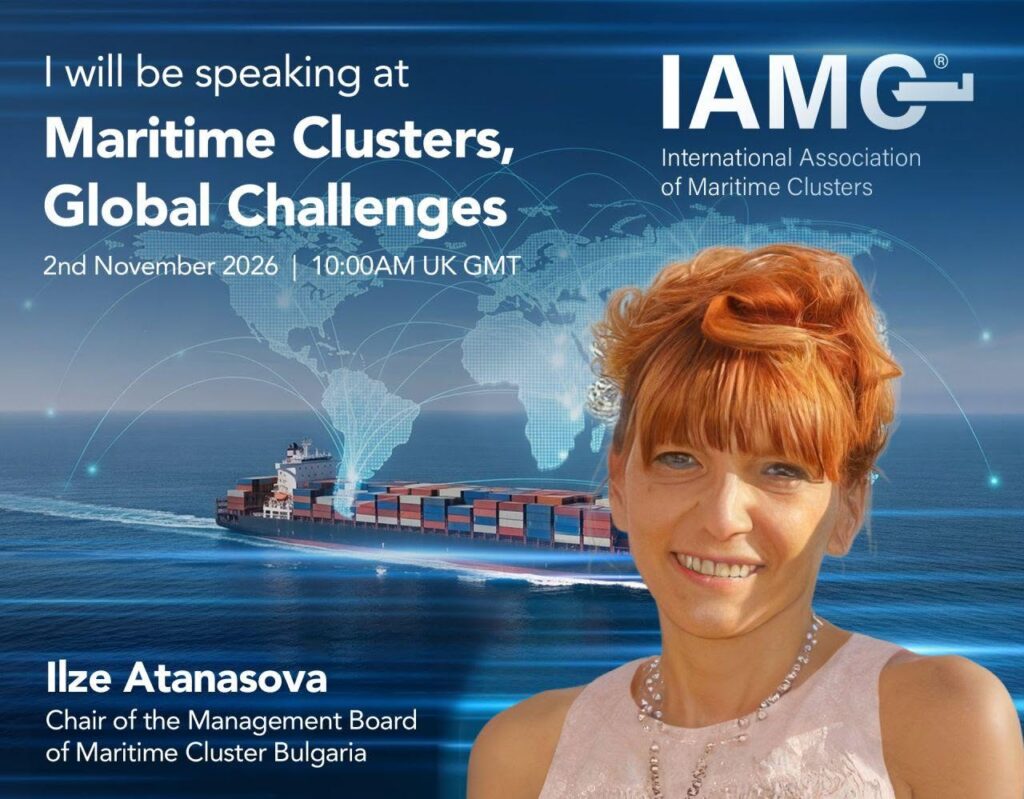
The Black Sea perspective was presented by Ilze Atanasova, Chair of the Management Board of Maritime Cluster Bulgaria, who described the cluster as being located at the meeting point between the European Union and the wider Black Sea region.
A particularly important point for Ukraine came when Ilze Atanasova spoke about cooperation between maritime organizations in the region and specifically highlighted the Ukrainian Maritime Cluster:
“There is one Ukrainian maritime cluster which was created and we work very well with them. They are also members of the European Network of Maritime Clusters.”
She pointed to joint projects, events and cooperation between organizations and academic institutions across the Black Sea region. A significant part of this work is focused on exchanging experience and identifying common regional priorities in maritime and Blue Economy development.
The discussion also showed how experience from maritime clusters beyond the region can help identify practices adaptable to the Black Sea context. For UMC, this reflects an approach already demonstrated through international initiatives such as the 4BIZ project, “Boosting the Blue Economy in the Black Sea Region,” implemented together with Maritime Cluster Bulgaria and other Black Sea partners.
“Trust, flexibility and access.” Ilze Atanasova used these three words to summarize the strengths of regional clusters. Their close knowledge of local ecosystems allows them to connect companies and research organizations with international initiatives and move more quickly from opportunities to practical implementation.
Shared challenges, shared solutions
Despite their regional differences, the panelists identified many shared priorities. People and skills, decarbonization and innovation emerged as key areas, alongside digitalization, investment and cooperation between industry, academia and public authorities.
The speakers also stressed that there is no single model for a successful maritime cluster. International cooperation makes it possible to exchange approaches and adapt successful practices to the specific needs of different maritime ecosystems.
Building connections across the maritime community
The panel reinforced an important principle: regional strength and international reach are not competing concepts. Regional clusters bring local knowledge and capabilities, while international networks help connect and amplify them.
For the Ukrainian Maritime Cluster, participation in ENMC and, through it, the wider IAMC community provides opportunities to share the Ukrainian maritime perspective, develop new partnerships and learn from other maritime ecosystems.
For Ukraine’s maritime sector, these connections are not only about international visibility. They provide practical links to expertise, innovation, partners and opportunities that can contribute to its long-term development and integration into the European and global maritime economy.